PROJECT: CYBERDECK MK-I
POCKET LINUX TERMINAL · PHYSICAL QWERTY · RADIO SUITE · VPS UMBILICAL_
00 · The Idea
Phones killed keyboards. Laptops don't fit in a pocket. This machine splits the difference: a 3D-printed clamshell around a cheap used flagship running real Linux (postmarketOS), a thumb keyboard, a software-defined radio, an off-grid mesh node — and a permanent SSH umbilical to my VPS, where my agents (codex, claude, the job-scraper fleet) already live.
The phone is the brain. A ₹374 microcontroller is the nervous system. The lid has a second screen that never turns off. Total cost: less than half of what an imported Linux phone kit sells for in India — and this one is mine, part by part.
01 · Inspiration
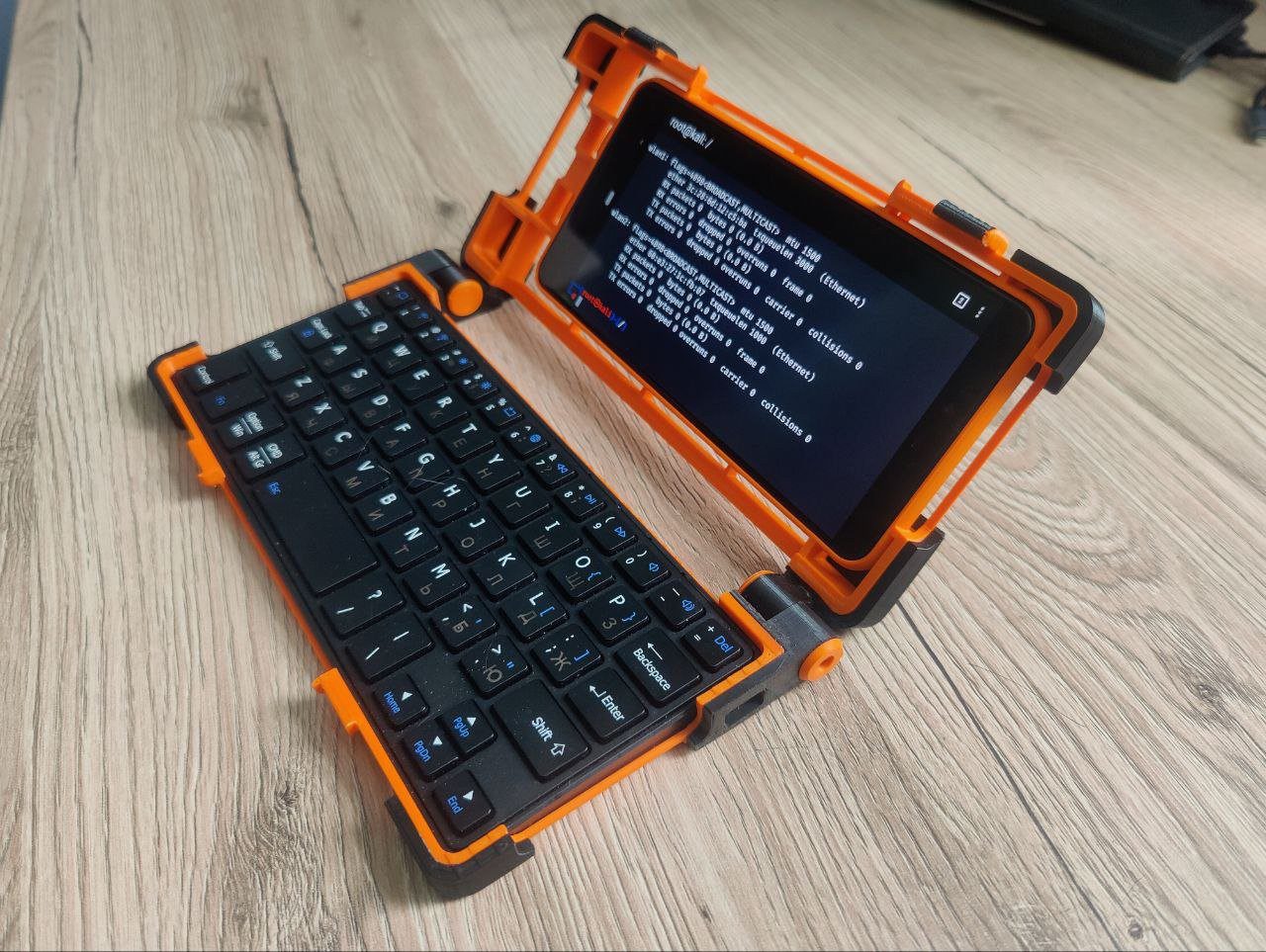
The spark: the Mobile C-deck — a 3D-printed phone-and-keyboard clamshell with swappable phone inserts, built by the hackaday cyberdeck community. It proved the concept, and it's where the shared-chassis idea comes from.
02 · My Take — General Arrangement
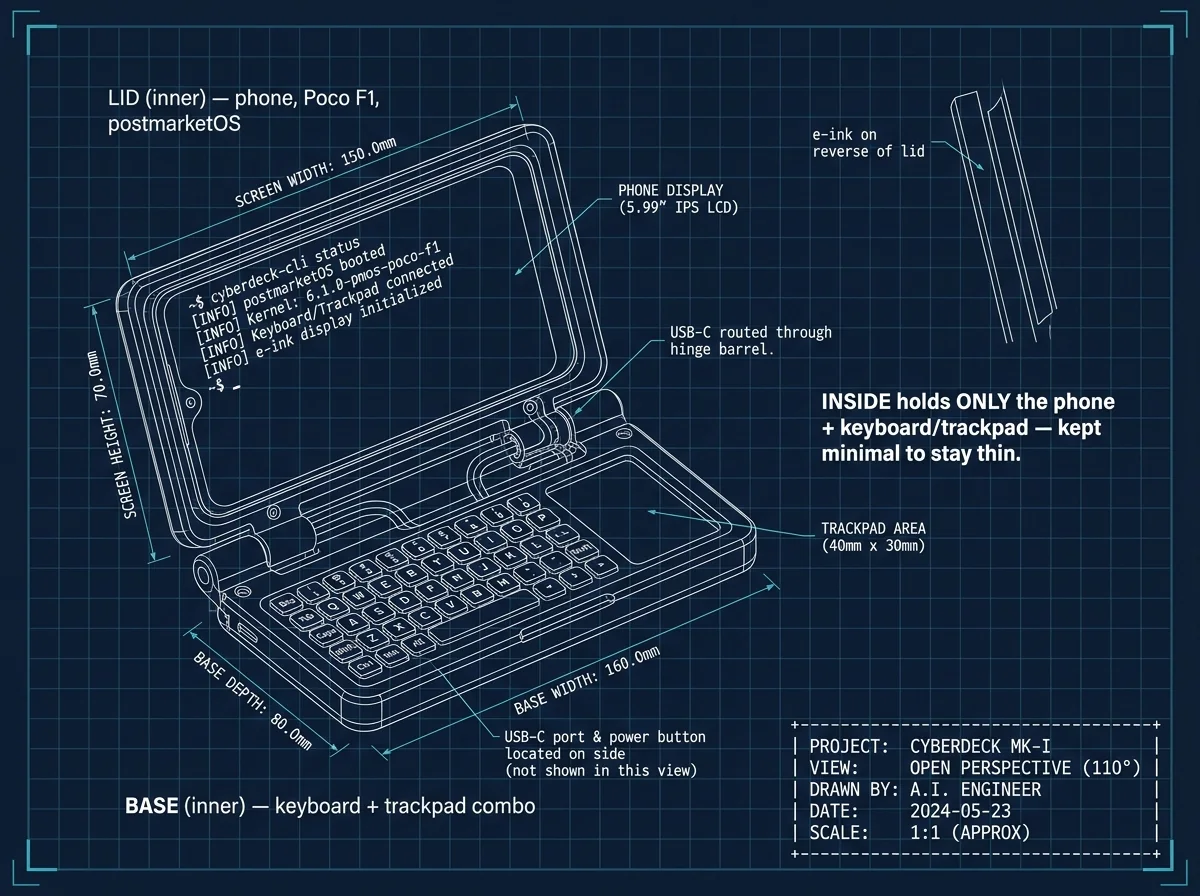
Everything from here is my spin on that concept: real Linux (postmarketOS), a software-defined radio, an off-grid mesh node and an e-ink ops board, in a clamshell I 3D-print myself.
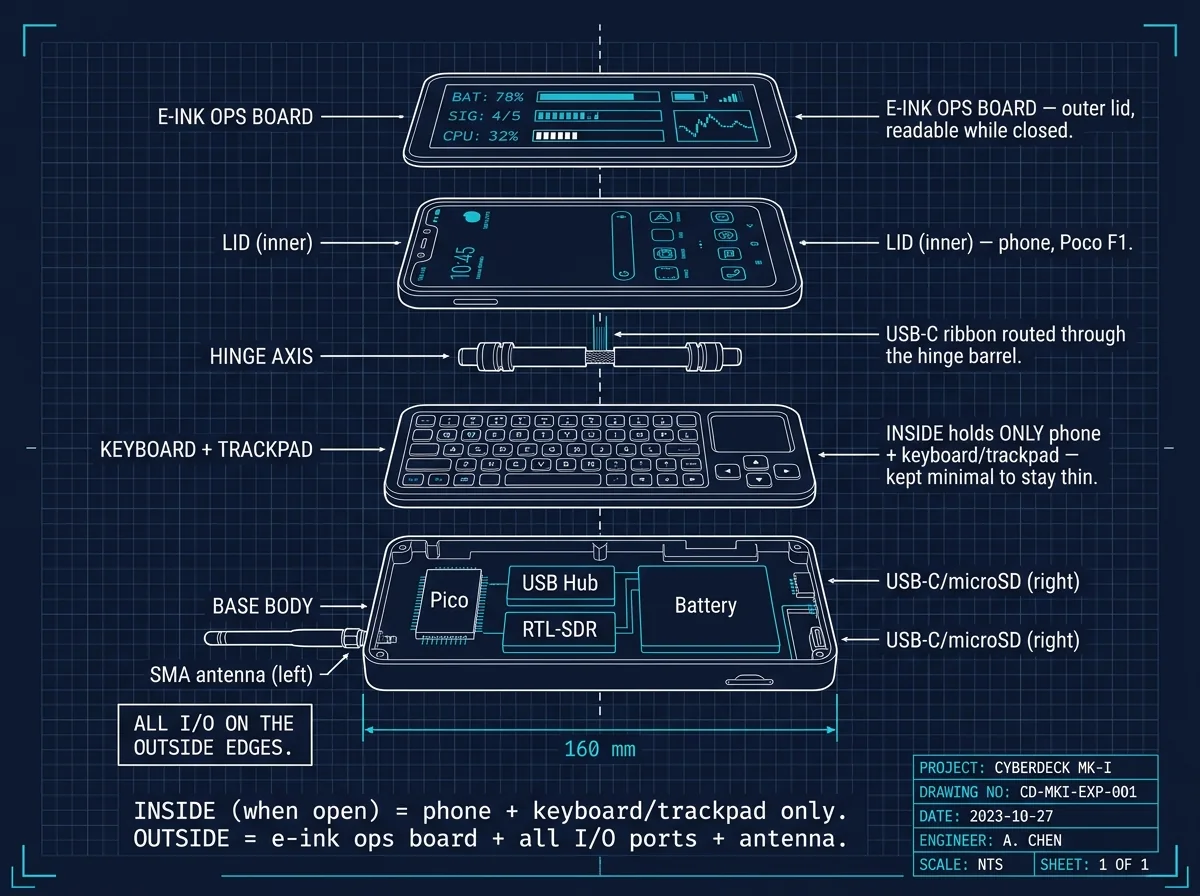
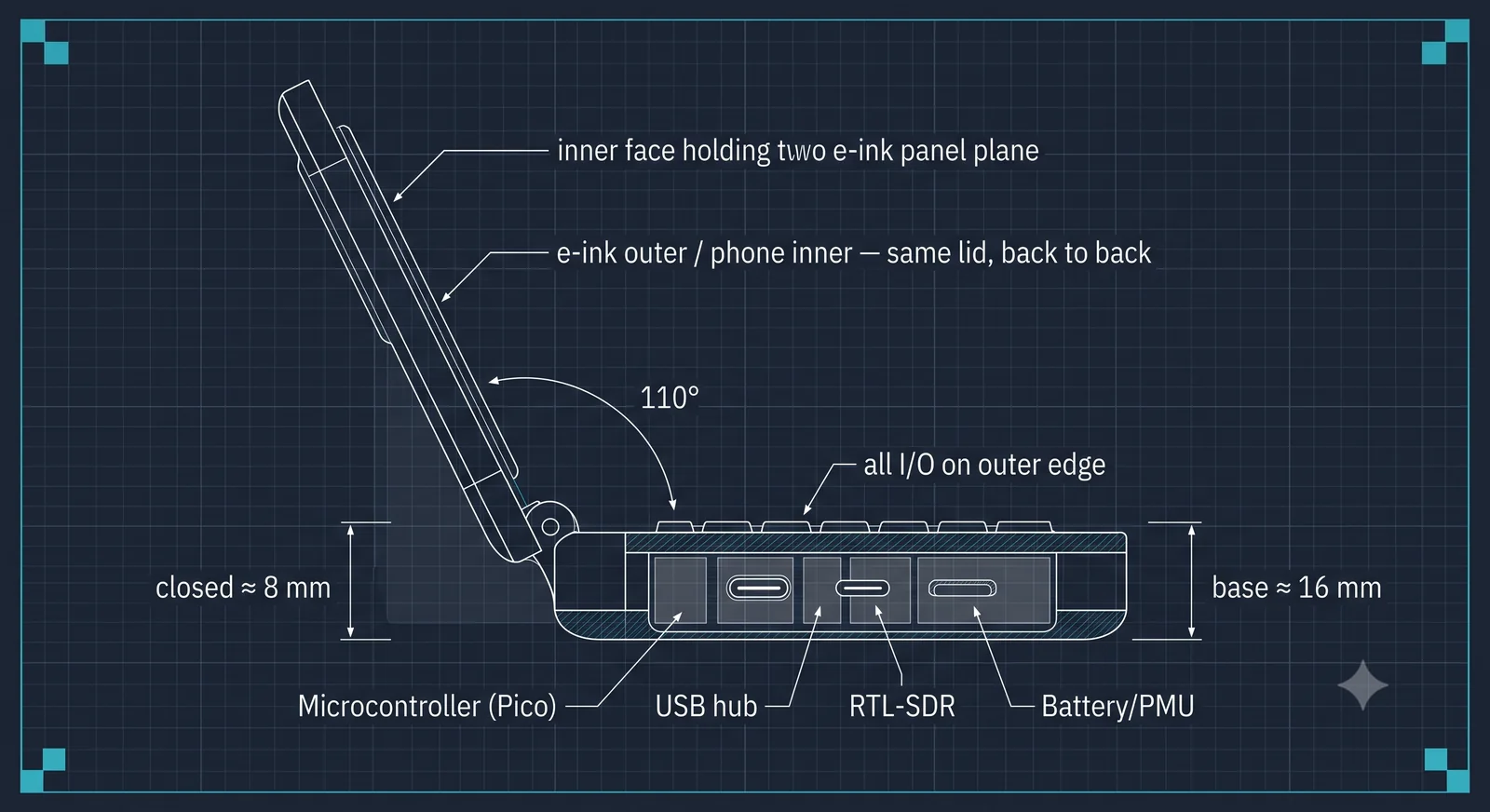
Layout rule: the inside faces stay minimal — open the clamshell and you see only the phone and the keyboard/trackpad, nothing else, to keep it thin. The e-ink ops board sits on the outside of the lid (readable while closed) and all I/O lives on the outer edges. Electronics and battery hide inside the base body, behind the keyboard.
03 · System Schematic
One rule organizes the machine: the phone computes, the Pico touches hardware. Everything meets at a powered hub.
04 · Capabilities
MISSION CONTROL
The lid e-paper is a permanent ops board for my VPS: job-scraper results, agent runs, quota meters — visible even with the deck powered off.
e-paper 4.26" · VPS push over SSH
RADIO SUITE
RTL-SDR receiver: track aircraft (ADS-B), decode weather-satellite imagery, listen to airband, sniff every 433 MHz sensor in the neighborhood.
100 kHz – 1.75 GHz · SMA on panel
OFF-GRID MESH
Meshtastic node on India's license-free 865 MHz band. Text + GPS between trek-mates with zero cell coverage; a hilltop solar repeater links valleys.
LoRa · no SIM · no license needed
ALIVE CASE
Proximity sensor wakes the panels as a hand approaches. Ambient light auto-dims LEDs at night. Addressable underglow through a translucent printed shell.
APDS9960 · WS2812B · PETG glow
05 · Detail: The Ops Board
06 · Detail: Mesh Over Terrain
07 · Build Phases & Budget
- 0
PROOF OF CONCEPT · ₹8–12k
Used Poco F1 (₹6–10k) + Bluetooth thumb keyboard (₹1.6k) + Termux. Does SSH-on-a-handheld feel right? One evening answers it.
- 1
DECK-IFY · + ₹3k
Flash postmarketOS. Print the clamshell (translucent PETG). Add Pico, in-case hub, WS2812 underglow, status OLED, IR blaster. It becomes a machine.
- 2
RADIO + POLISH · + ₹10k
RTL-SDR + panel SMA + telescopic antenna. 4.26" e-paper ops board in the lid. Acrylic windows, hex grille, decals. Meshtastic node.
TOTAL ≈ ₹21–25k vs ₹60,000 quoted for an imported PinePhone + keyboard in India — half the price, triple the capability.
08 · Key Specifications
| ITEM | SPEC |
|---|---|
| Compute | Xiaomi Poco F1 — Snapdragon 845 · 6 GB RAM · 4,000 mAh · USB OTG verified working under postmarketOS |
| OS | postmarketOS (Alpine Linux, mainline-adjacent) · fallback: Android + Termux on identical hardware |
| Peripheral controller | Raspberry Pi Pico (RP2040) as USB-CDC sidecar — owns LEDs, IR, sensors, lid panel |
| Radio | NooElec NESDR (RTL-SDR) · Meshtastic LoRa node @ 865 MHz (IN license-free band) |
| Displays | Phone 6.18" main · 4.26" e-paper persistent ops board in lid |
| Uplink | SSH → VPS (agents run server-side; deck is the cockpit) · claude-code runs on Alpine natively if needed |